
What is EC & BIOS Handshake?
Quick note explaining EC & BIOS Handshake for BIOS/UEFI and embedded firmware readers.
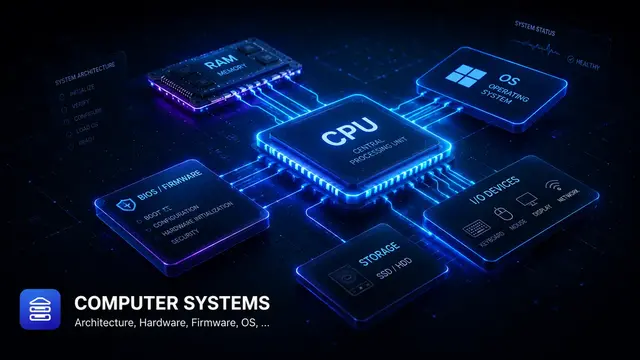
EC and BIOS handshake is the coordination between platform firmware and the Embedded Controller for power, thermal, battery, keyboard, or platform-status flows.
Why it matters
- Describes how firmware exposes hardware behavior to the OS.
- Helps connect schematic-level signals with OS-visible devices.
- Useful for debugging boot, power, and device-enumeration issues.
Practical example
Example: when a device is visible in firmware but not in the OS, compare ACPI namespace output, OS logs, and the resources returned by _CRS.
Quick checklist
Quick takeaway
EC & BIOS Handshake is the contract between firmware description and OS interpretation.
A debugging angle
I try not to treat EC & BIOS Handshake as a dictionary entry. I read it as part of a firmware path: who produces it, who consumes it, and what symptom appears when it is wrong. That habit makes the note useful during debugging, not only during study.
A small field example
For example, when an OS cannot see a device, the driver is not always the first suspect. I would compare the firmware description with the OS view: IDs, resources, table contents, and logs. EC & BIOS Handshake is one piece of that platform description chain.
In a real debugging session
For EC & BIOS Handshake, I usually ask four questions: which firmware phase sees it, which module produces it, which module consumes it, and where the symptom appears when it is wrong. That turns a BIOS/UEFI definition into a useful debug checkpoint.
When a DXE driver does not bind or BDS stops at an unexpected point, avoid staring at one error line only. Walk backward through protocols, handles, device paths, variables, and policy decisions. Firmware failures are usually chained.
Related notes
- ACPI Table Types: key points
- What is ACPI Namespace?
- What is AML?
- What is ACPI Method?
- What is USB Initialization in DXE?
Public references
Found this useful?
Save it or share it with someone learning firmware, BIOS/UEFI, and embedded systems.
Nội dung liên quan
Một số bài viết, ghi chú hoặc project có liên quan đến nội dung bạn vừa đọc.
Embedded Controller OperationRegion
How AML talks to EC RAM through EmbeddedControl OperationRegion and how to debug EC timeout, SCI storm, battery, thermal, and hotkey issues.
OperationRegion Deep Dive
How ACPI OperationRegion connects AML methods to EC RAM, system memory, I/O ports, PCI config, GPIO, and other hardware-backed address spaces.
Sleep and Wake in ACPI
How ACPI describes sleep states, wake sources, power methods, and the common debug path for instant wake, failed resume, and device wake bugs.
Biến note thành bài viết hoàn chỉnh
Notes là nơi ghi nhanh khái niệm.